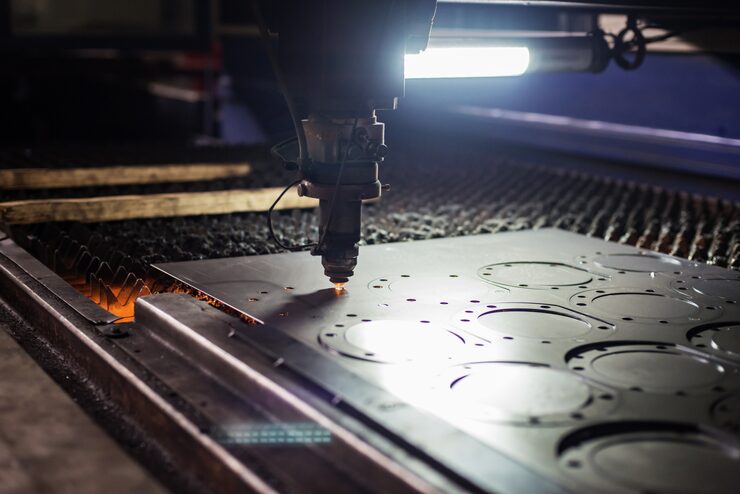
Thick plate cutting often pushes fabrication equipment to its limits, yet advanced plasma systems have introduced methods that turn difficult jobs into predictable outcomes. Manufacturers working with heavy steel rely on technology that not only slices through dense material but also keeps accuracy consistent. A modern CNC plasma cutting machine provides several advantages that improve speed, precision, and overall efficiency in industrial environments.
High Amperage Output Enabling Deep Material Penetration
One of the defining features of a CNC plasma cutting machine is its ability to operate at higher amperages, which directly increases penetration depth. This means it can slice through thick plate without requiring multiple passes or secondary processes, saving both time and cost. The strength of the arc ensures clean edges even in steel sections that previously required oxy-fuel methods.
Deep penetration is especially valuable for industries building heavy equipment, offshore structures, or transport components where thicker materials are standard. By maintaining steady output, the plasma system delivers cuts that hold tolerance even under extended operation, giving fabricators confidence in their results without needing excessive rework.
Reduced Bevel Angles for Accurate Fit up of Components
Cutting thicker materials often introduces wider bevel angles, which create gaps during component assembly. Advanced plasma systems reduce this effect by maintaining a narrow kerf and more controlled cut face. That precision helps in producing edges that fit tightly together, reducing the need for fillers or extensive welding adjustments.
Better fit-up directly translates to stronger weld joints and faster production cycles. For manufacturers who frequently ask about CNC companies near me, the reduced bevel angle capability becomes a key factor in selecting a provider. It shows that precision in heavy plate work is achievable with the right plasma system.
Clean Start and Stop Points on Heavy Gauge Sections
Heavy gauge steel usually reveals imperfections at the start and end of a cut. A well-configured CNC plasma cutter minimizes this issue by controlling the arc initiation and termination points with advanced software. This results in smoother transitions and eliminates weak spots that can compromise structural reliability.

The ability to maintain consistent quality across start and stop zones also ensures less manual grinding or touch-up afterward. For industries where time is as valuable as material, such precision reduces delays and boosts productivity without compromising quality.
Controlled Dross Levels Lowering Post Cut Clean up
Dross accumulation is one of the main challenges in thick plate cutting. A plasma cutter designed for high power control manages heat input effectively, lowering the buildup of molten material along the edges. This makes post-cut cleanup significantly faster, minimizing grinding and sanding requirements.
Less dross not only saves time but also protects the edge from microfractures that could affect long-term durability. Companies that focus on large-scale fabrication often see a direct improvement in efficiency, allowing teams to reallocate time from cleanup to actual assembly.
Extended Torch Life When Cutting Thicker Materials
Heavy-duty cutting puts immense strain on consumables, especially the torch. Modern CNC plasma cutting machines extend torch life through advanced cooling systems and optimized gas delivery. These features keep the torch components from wearing prematurely, reducing downtime and replacement costs.
For operators, longer torch life means fewer interruptions in production and lower operational expenses. It also ensures consistent performance across multiple cutting cycles, which is especially important in industries running continuous shifts or handling oversized contracts.
Reliable Cut Path Stability on Oversized Plate Formats
Handling oversized steel plates requires stable and predictable cutting paths. A CNC machine company designing for industrial demands integrates precise motion controls that prevent deviations, even on large sheets. This ensures every line follows the programmed path, avoiding misalignments that could waste valuable material.
The advantage of reliable cut stability becomes even more pronounced on complex geometries where small errors multiply quickly. Fabricators depend on this consistency to maintain high-quality standards without excessive oversight or adjustment during production runs.
Flexible Thickness Handling with Minimal Operator Adjustment
Cutting different plate thicknesses normally requires several setup changes, but advanced plasma systems simplify this with automated adjustments. The machine calibrates amperage, gas flow, and cutting speed according to material density, reducing reliance on manual input.
This flexibility lets operators handle diverse projects without constant recalibration. It also allows shops to expand their range of work while maintaining consistent accuracy, making the investment practical for both small runs and high-volume production.
Uniform Results Achieved on Structural Grade Steel
Structural grade steel presents unique challenges because of its hardness and composition. A CNC plasma cutter provides uniform results by balancing heat input across the entire cut path, preventing warping or uneven edges. This is critical when fabricating beams, frames, or load-bearing components.
Uniformity in structural steel work reduces the risk of failures during later stages of fabrication or construction. For manufacturers relying on accuracy and repeatability, the consistent output reinforces the value of working with advanced plasma technology rather than traditional cutting methods.
